Editorial: Why Nostrum?

Nostrum Editorial Board

Many of us have had a similar experience over the past few weeks. When sharing that we decided to name this new publication “Nostrum”, we heard: but why? Why would we purposefully give our publication a name that means something like “a cure that doesn’t work”? Aren’t we just undermining ourselves and what we know, right at the beginning of our career as medical students? Moreover, aren’t we undermining the entire practice of medical humanities, by calling it ineffective?

Perhaps. But that is not our intent. See, nostrum does not exactly mean a cure that doesn’t work. If you look at our definition on the home page, it means a medicine that has not been proven to be effective (presumably by peer-reviewed standards), made by someone who is not particularly qualified (by traditional standards, perhaps).

What we hope to project, by embracing the name “Nostrum” for our new publication, is just this tension: that real and powerful kinds of knowledge exist among those deemed to be unqualified, too young, too inexperienced.

We hope that this publication will serve as a community touchpoint among trainees, students, and/or learners to imagine what the future of health and health care can and should look like. After all, we’re the ones who are going to be practicing and caring in (and out of) it.

We hope you enjoy!
nailed it

Nghiem Nguyen
Medical Student, Kaiser Permanente School of Medicine

While I was away
Learning about Marxism
and critical race theory
My mother
Was working 12 hours a day
7 days a week
Smiling at white hands
In exchange for tips
I write a grant
To screen a documentary
About health conditions
of nail salon workers
at my college
And roll my eyes
When my mother comes home
And tells me to massage her back
When did I learn
To turn my bruises
Into callouses
When did I learn
to cover up relationships
With theory
To cope with the fact
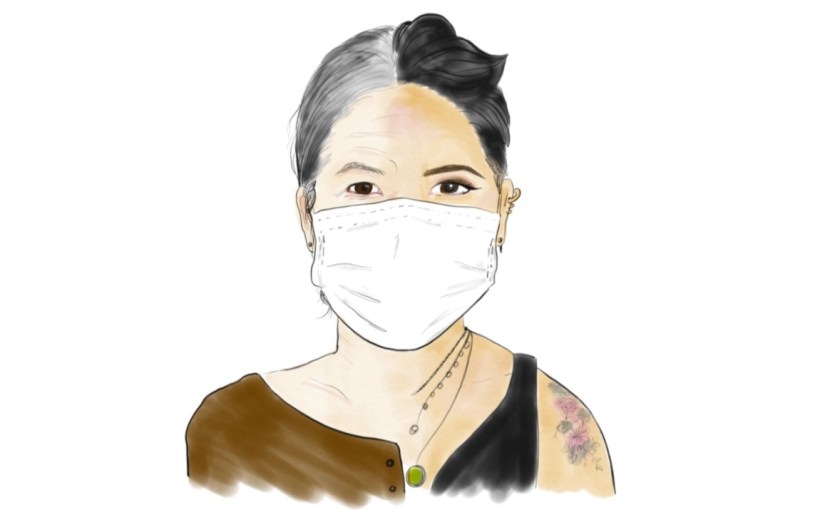
That my mother wears a mask to filter out toxins
And I wear a mask to filter out shame

Comfort box

Ben Metrikin
Medical Student, Kaiser Permanente School of Medicine

  1. When my grandfather was in hospice care, we received a box of medications from one of his nurses. She left it at the front door. It contained medications like alprazolam, morphine, and haloperidol in little pill boxes. Opening the box revealed a curt set of instructions listed on a piece of paper, detailing when and how to give the medications. If the patient appears uncomfortable, give haloperidol.
  2. I read somewhere about the archeology of language – like cities built around the ruins of older cities. Like Rome. Like those little eggs my mom would get us, the ones that we poured water over and scraped at until we found the little plastic toy hidden inside. Like she knew that words come into being as accidents, constrained by and created out of the histories that surround them. Words congealed like cold butter.
  3. Many people think English is the hardest language to learn. I wouldn’t have known (I took French in high school and promptly forgot it). So many words that sound similarly but mean differently. Vice versa, too. What a nightmare.
  4. I’m not convinced that English is the hardest language to learn; I think it’s medicine. Even with Latin, there are rules to the game. Many of those rules are similar. With medicine, it’s different. You learn to break the body apart, piece by piece, until the constituent parts no longer look like a coherent whole. Like doing a puzzle where the picture is already on the box – a different kind of game.
  5. The comfort box instructions consisted of a numbered list, as if to provide order to the jumbled contents.
  6. My grandpa’s pills, in their bottles, in the comfort box, in the fridge – we knew their mechanism of action, their biochemistry. But it was their mythology which we struggled to understand the most, the lives that they lived beyond the pill bottle. My grandmother didn’t know why morphine was in the box, why we (of all the however-many-billion-people in the world) were expected to keep my grandfather’s death drug in our freezer. Sometimes we weren’t sure if the medications were for him or for us. For us, perhaps, so we didn’t have to see – immediately, apparently – his tossing and turning. He never told us how he wished to die.
  7. For secretions in the mouth or throat, use atropine.
  8. When my grandfather was discharged from the hospital the first time, the plan was for him to come in to see the doctor every few weeks for radiation and chemotherapy, donning a mask and gloves. Without any help from any of us, he waded out into the streets, hopped in a car, and went into the oncologist’s office for treatment.
  9. Look again, closely, two weeks later: there were only 12 red steps separating his apartment from the street, but they had become insurmountable. His legs were getting weaker and could no longer support him. He was still himself – tall, strong, sturdy – but had to drape an arm around my shoulder, now, to get up and down those stairs. 
  10. Why did doctors feel the need to name diseases after themselves? As if to conquer some specific biochemical process, to plant their flag in a medical aberration. As if to say: this part, right here, is mine. It might be part of your body, but it’s mine! To me, at least, it seems like an unwelcome intimacy.
  11. During those few weeks, while my grandfather got sicker and sicker, we walked up and down those stairs in tandem. Some neurological effects of the chemotherapy, maybe, or just the cancer spreading? My body slowly took on the weight of his as his legs began to fail him. At first, I merely let him push down on my shoulders while he grabbed onto the railing, letting him lean against a wall to catch his breath once we reached the bottom of the stairs. Days later, I was pushing him up each red stair, holding onto his body for fear that he would fall.
  12. It was a strange kind of intimacy: as I grasped his torso on either side to propel him up those stairs, I felt each rib as they slid underneath skin. When I wedged my shoulder underneath his legs to stop him from falling, I felt the atrophying muscles tightening with the massive effort each step took. Even so, we were masked and gloved, sanitized before and after — our spheres as separate as we could possibly make them while my body took on the functions of his.
  13. If the patient appears agitated, use lorazepam. 
  14. The comfort box sat in the freezer, largely untouched. Towards the end, we argued endlessly about which medications to give. Two doctors in the room (my dad and my uncle) and still no clarity, no formulaic certainty about what kind of comfort we ought to provide. To be fair: what is the difference between discomfort and agitation, when the patient can’t provide any spoken clarity?
  15. The hospice doctor called before the oncologist did; we could hear it in his voice, even if he never said it. Upon reflection, no one ever said it; or maybe there was no “it” to say. Maybe “lymphoma” was enough, even if “lymphoma” didn’t normally move so quickly. Maybe no name was better than having one.
  16. For me the noise of Time is not sad: I love bells, clocks, watches — and I recall that at first the photographic implements were related to techniques of cabinetmaking and the machinery of precision…1
  17. When the funeral home took the body, at 7:30am, right as the sun was rising, we hardly had a word to say.
  18. There was a small café right outside the apartment where I grew up in New York. Despite the rickety wooden bench that sat outside of it, the café recalled a French patisserie. There was always a cake in the front window, crafted graciously and exquisitely, but not extravagantly. Each year, right around when summer would turn into fall, my grandfather would sit my brother and I down on that bench, in front of a different cake, and take our picture. There is a series of those photos, all the way from when I was two years old until I left for college. In each photo, you can see my brother and I sitting next to each other, smiling at the camera, slowly growing older.  

(1) Barthes, Roland. “Camera Lucida”. Hill & Wang, 2010.

Do you feel the aftershocks?

Lucas Saporito
Medical Student, Kaiser Permanente School of Medicine

You felt the earthquake.
The shake in moral the ground as it radiated around.
Some buildings shook, some buildings swayed
Some buildings fell to their knees and prayed.

But did you feel the aftershocks?
The rock we stand on stressed again and again.
We all knew it was coming,
But then the question was how big and when.

Did it shake you down to your core?
The floor you stand on no longer strong
From years of being cut and chipped away
By chisels hardened with fear and hate.

Or did you sleep through the aftershocks?
Behind lock and key, fell back asleep
With the comfort that your house’s foundation
Was never threatened by the Earth’s vibration.

How might the aftershock reopen scars?
The bars that stopped so many from reaching the top
Appear taller now as buildings crash down
From tremor after tremor in the hollow ground.

But are not some aftershocks manmade?
They bade goodbye to years of oppression.
They cry for this twisted system we live in to fall
And ask everyone, in unison, to answer the call.

Will you feel those aftershocks?
There will be more, so if you choose to ignore
Them you will find that you cannot.
You will feel them. They won’t be for naught.

Lacuna

Sophia Liang
Medical Student, Kaiser Permanente School of Medicine

If I could just listen to words 
And verbs and phrases just like 
Everyone else without outside help  
Without having to process all the extra information 
Sensations, ambiguity, body language 
And know what the person is trying to say 
Instead of bending my comprehension in machinations 
Around unyielding impossibilities like  
Assumption or implication or even someone else’s emotion 
I don’t know how to impute naturally what you feel 
I don’t know how to acquire what you mean 
I can only see the world from myself 
A single point of view stretching linearly into perspective  
But others I think or I have heard 
Exist and comprehend on a different spectrum  
Where things just come naturally or are taught to them 
From a young age, the ability to gauge 
A room socially appropriately engagingly  
While I stand off in the corner 
Wondering what really is being said   

Look out for your Black folks

Makeen Yasar
Equity, Inclusion, & Diversity Coordinator, Kaiser Permanente School of Medicine

when you think you’re alone
find comfort where the light don’t touch
in the shroud of dusk and royal skies
where the sun’s head is laid to rest
and you can sit in the sand with the dark’s good company

she tells me I am safe here, at least for awhile
and to mind the visitors that she has called to the shoreline
to look for my kinfolk who tread across sand underneath the dock

silver braids on ivory skin fall past a grey dress, parted by her lover’s arms
waves sit atop his head like the waters
behind them, a boy’s Afro puff can be seen
held tightly by a band of brothers who lumber through the grain
as a procession of bikers pass through like azure streaks
their skin flashes bronze over dusty cement

this is the comfort we find by the pacific
this beach has become sanctuary in the years since we’ve came
and in the shroud of dusk and royal skies
we are family
as we sit here in the arms of night
connected by a thread